✨ New Arrivals Just Dropped!Explore
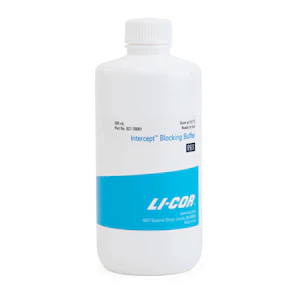
Li-Cor Intercept (PBS) Blocking Buffer, 500mL, Each Each
Li-Cor Intercept (PBS) Blocking Buffer is a specialised solution designed for use in immunoassays, particularly in applications where reduced background and improved signal clarity are essential.
Its based on phosphate-buffered saline (PBS), which provides a stable pH and osmotic environment conducive to biological assays. Contains proprietary blocking agents that effectively minimise non-specific binding. These agents are optimised to reduce background noise while preserving the signal from specific interactions, such as those in Western blots or ELISA assays. Helps to reduce non-specific binding of antibodies to the membrane, improving the specificity of the detection. Used to block non-specific binding sites in microtiter plates, ensuring more accurate and reliable quantification of target molecules.
The buffer should be stored according to the manufacturer's instructions, usually at 4°C, and used within the recommended timeframe to ensure optimal performance.
Its based on phosphate-buffered saline (PBS), which provides a stable pH and osmotic environment conducive to biological assays. Contains proprietary blocking agents that effectively minimise non-specific binding. These agents are optimised to reduce background noise while preserving the signal from specific interactions, such as those in Western blots or ELISA assays. Helps to reduce non-specific binding of antibodies to the membrane, improving the specificity of the detection. Used to block non-specific binding sites in microtiter plates, ensuring more accurate and reliable quantification of target molecules.
The buffer should be stored according to the manufacturer's instructions, usually at 4°C, and used within the recommended timeframe to ensure optimal performance.
$533.50
Li-Cor Intercept (PBS) Blocking Buffer, 500mL, Each Each—
$533.50
Product Information
Product Information
Shipping & Returns
Shipping & Returns
Description
Li-Cor Intercept (PBS) Blocking Buffer is a specialised solution designed for use in immunoassays, particularly in applications where reduced background and improved signal clarity are essential.
Its based on phosphate-buffered saline (PBS), which provides a stable pH and osmotic environment conducive to biological assays. Contains proprietary blocking agents that effectively minimise non-specific binding. These agents are optimised to reduce background noise while preserving the signal from specific interactions, such as those in Western blots or ELISA assays. Helps to reduce non-specific binding of antibodies to the membrane, improving the specificity of the detection. Used to block non-specific binding sites in microtiter plates, ensuring more accurate and reliable quantification of target molecules.
The buffer should be stored according to the manufacturer's instructions, usually at 4°C, and used within the recommended timeframe to ensure optimal performance.
Its based on phosphate-buffered saline (PBS), which provides a stable pH and osmotic environment conducive to biological assays. Contains proprietary blocking agents that effectively minimise non-specific binding. These agents are optimised to reduce background noise while preserving the signal from specific interactions, such as those in Western blots or ELISA assays. Helps to reduce non-specific binding of antibodies to the membrane, improving the specificity of the detection. Used to block non-specific binding sites in microtiter plates, ensuring more accurate and reliable quantification of target molecules.
The buffer should be stored according to the manufacturer's instructions, usually at 4°C, and used within the recommended timeframe to ensure optimal performance.